An open specification for composing reusable playbooks into domain teams. Goals drive the work, connectors bring the data, and experts guide improvement.
Start with how teams wire agent skills and tools together today. Then see where the spec begins: standard playbooks that teams can share, compose into personas, and run against goals. The walkthrough follows the work through connectors and custom apps, then shows how the harness rehearses a proposed action, asks a person to approve it, and records the live result.
Current practice · Agent skills
Start with an agent skill.
Teams today can give an agent a skill: reusable instructions for a task, sometimes bundled with scripts or reference files.
A skill helps the agent do its part. A larger process still needs someone to decide how skills work together, which tools they can call, and when a person needs to review the result.
Agent skill
Instructions
Reference files
Optional scripts
Current practiceA skill gives an agent reusable instructions and may include supporting files.
Current practice · Custom wiring
Then wire the pieces together.
When teams stitch skills and tools together with custom scripts, handoffs depend on local conventions. One skill’s result may need reshaping before the next can use it.
Moving the workflow to a new team can mean rebuilding those handoffs and access rules. An expert’s correction can be lost before the next run.
Agent skill
Skill B
Skill C
Tool access
App data
Unclear handoffs
Repeated setup
Feedback lost
Current practiceCustom scripts and tool setup tie skill handoffs to one environment.
Proposed standard · The playbook contract
The spec starts with standard playbooks.
The Domain-Specific Agent Harness Spec proposes a shared way to define and compose workflows. Gabriel calls the reusable unit a playbook. It declares its inputs, steps, outputs, connector operations, and approval rules.
A playbook can use skills for instructions and domain knowledge. Its steps declare the capabilities they need. The workspace binds those capabilities when the playbook runs, so the team can reuse the same definition.
Proposed standardA standard playbook adds a contract for how the work runs and fits with other playbooks.
Proposed standard · Standard composition
Compose teams into a persona.
A persona brings together teams. Each team contains its goals and the playbooks they use. The domain ontology maps the organization’s apps and data into shared concepts, so those teams agree on what the work means.
A persona can work with text, speech, images, video, and audio. A spoken request can use speech-to-speech directly or use speech-to-text, a text model, and text-to-speech.
Proposed standardA persona packages teams and their playbooks with a shared domain model.
Proposed standard · Goals invoke playbooks
The goal chooses the work.
Create a goal inside a team. The goal selects and invokes the playbooks that belong to that team, in the order the outcome and their dependencies require.
Agents run the selected playbooks and skills inside the harness. The workspace binds models to the capabilities each step needs through a compatible provider or gateway. Anthropic, OpenAI, Gemini, Grok, and Kimi K2 are examples.
Proposed standardA goal selects and invokes playbooks in the team. Their dependencies determine the order.
Proposed standard · Create a missing playbook
Missing a playbook? Create it.
When a goal reveals a missing capability, the team can draft a playbook for it. The new definition declares its inputs, steps, outputs, and connector requirements.
Review and register it before adding it to a plan. Later goals can reuse the reviewed definition.
Playbook
Playbook B
Playbook C
New capability
New playbook
Persona
Team
Goal
Select · order · invoke
Draft the missing playbook
Harness
Proposed standardA goal can reveal a missing capability. The team can draft, review, and register a playbook for it.
Proposed standard · Connectors and data
Connect playbooks to real data.
During execution, playbooks use connectors to retrieve data, update records, and share results with external services.
The harness resolves each required operation to an authorized connection. The same domain mappings make the data understandable across the team.
Proposed standardThe vault supplies credentials to the authorized connection used by the connector.
Proposed standard · Custom apps
Build apps on the same connections.
Agents can create custom apps that read connector data and display it as graphs, tables, or working interfaces. Apps can also consume the outputs that playbooks produce.
Agents use authorized operations to write changes back to the source services or the custom app’s data. The app gives people a place to see and work with the result, including through an externally hosted interface.
Proposed standardCustom apps use connector data and agent outputs. Agents can write changes back through those connections.
Proposed standard · Governed execution
Rehearse the change. Then approve it.
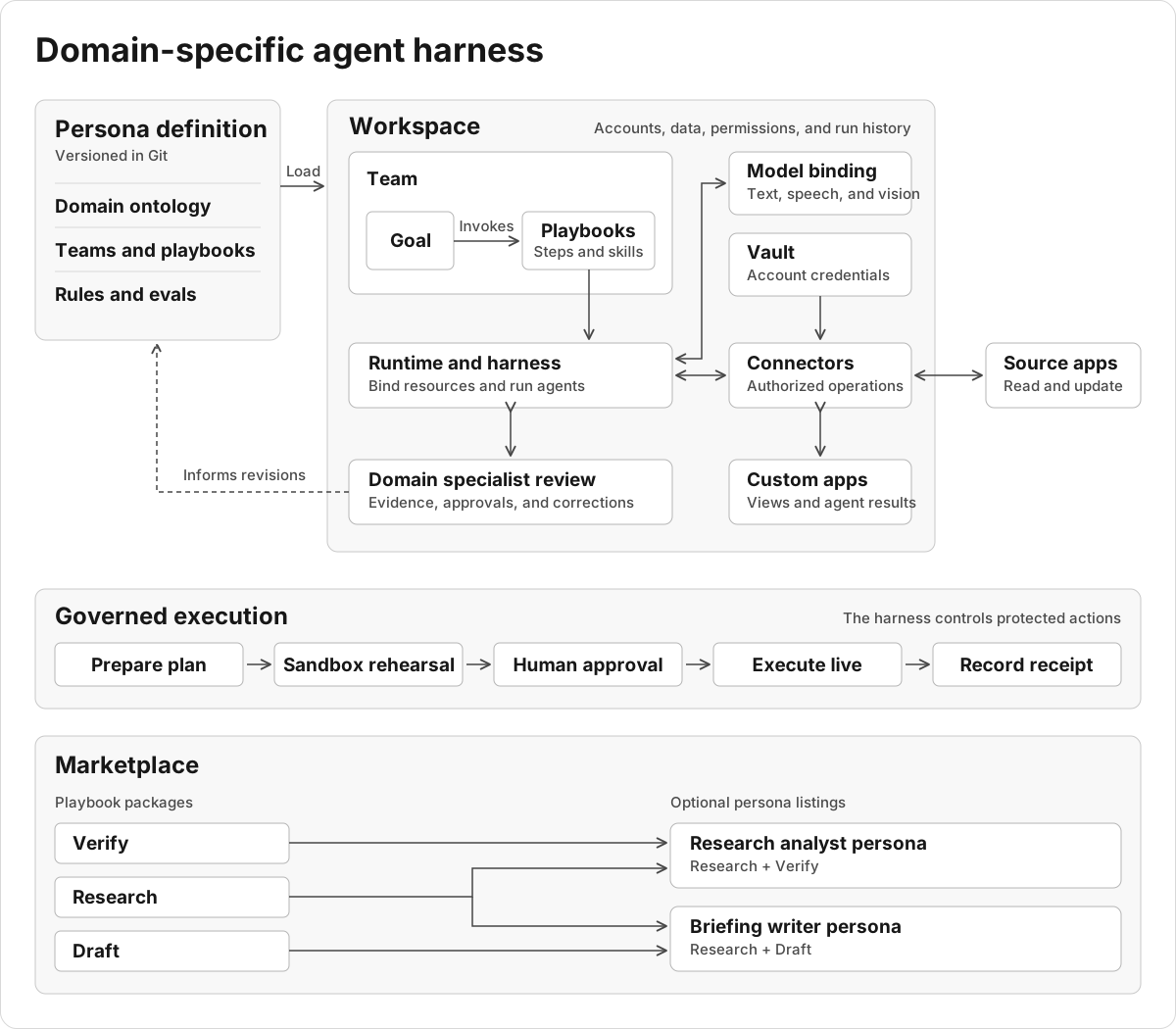
When the team’s goal calls for a change to app data, the playbook drafts the action. A domain specialist can clarify the scope or correct the plan. The harness rehearses the proposed change in a sandbox with live effects disabled.
The specialist reviews the rehearsal and approves the exact action. The harness rechecks the approval before sending the action through the same connector shown above. The live receipt and the specialist’s feedback inform the next reviewed playbook revision.
Proposed standardThe harness rehearses the playbook’s proposed change. The specialist approves the exact action before it reaches the live connector. The receipt informs future playbook revisions.
Proposed standard · Reuse across personas
Scale by reusing the work.
A playbook from the registry can serve several teams, including teams in different personas. Each goal invokes the work it needs with its own inputs and domain mappings.
Each workspace keeps its own connector accounts, vault, data, and approvals. A reviewed package revision can be adopted without rebuilding the entire composition.
Playbook package
Playbook registry
Persona
Team
Connectors
Vault
Workspace A
Workspace B
Persona B
Team
Connectors
Vault
Own accounts + data
Own accounts + data
Proposed standardReuse a playbook across teams and personas. Each workspace supplies its own accounts, data, and approvals.
Proposed standard · The complete harness
This is a domain-specific harness.
A persona groups playbooks into teams around a domain model. Goals inside each team invoke the playbooks they need. A missing capability can guide a new playbook draft. Agents execute that work inside the harness, using the skills and model capabilities each step needs.
Connectors move the data. The vault supplies account credentials. Custom apps make the data and results usable. Domain specialists guide decisions, review rehearsals, and approve protected effects. Run evidence helps them improve the harness.
Proposed standardTeam goals invoke playbooks. The harness binds models and coordinates execution, data access, apps, and expert review.
Proposed standard · Marketplace
Mix and match playbooks to build personas.
The proposed marketplace lets teams discover standard playbook packages and combine them into personas. Pair Research with Verify to build a research analyst, or pair Research with Draft to build a briefing writer.
Authors can publish individual playbooks or list a complete persona when they want to share the whole setup. Team definitions pin the playbook revisions they use.
SKILL.md provides instructions. Definition files describe the data and workflows. The registry pins the Git revision and fingerprint of each linked definition.
Draft 0.1 comes from personas running on Gabriel Operator. The Portable Persona Runtime installer deploys published personas to a self-hosted runtime appliance.
Read https://gabriel-operator.github.io/domain-specific-agent-harness-spec/llms.txt and the pages it lists before you author a persona or implement a runtime.