Terms and standards
A persona is the versioned definition of a domain, its teams, and the playbooks they use. A runtime imports it and coordinates work. An agent harness runs the model and tool loop for an agent. These terms describe responsibilities that an implementation can put in the same process or in separate services.
Manifesto
Section titled “Manifesto”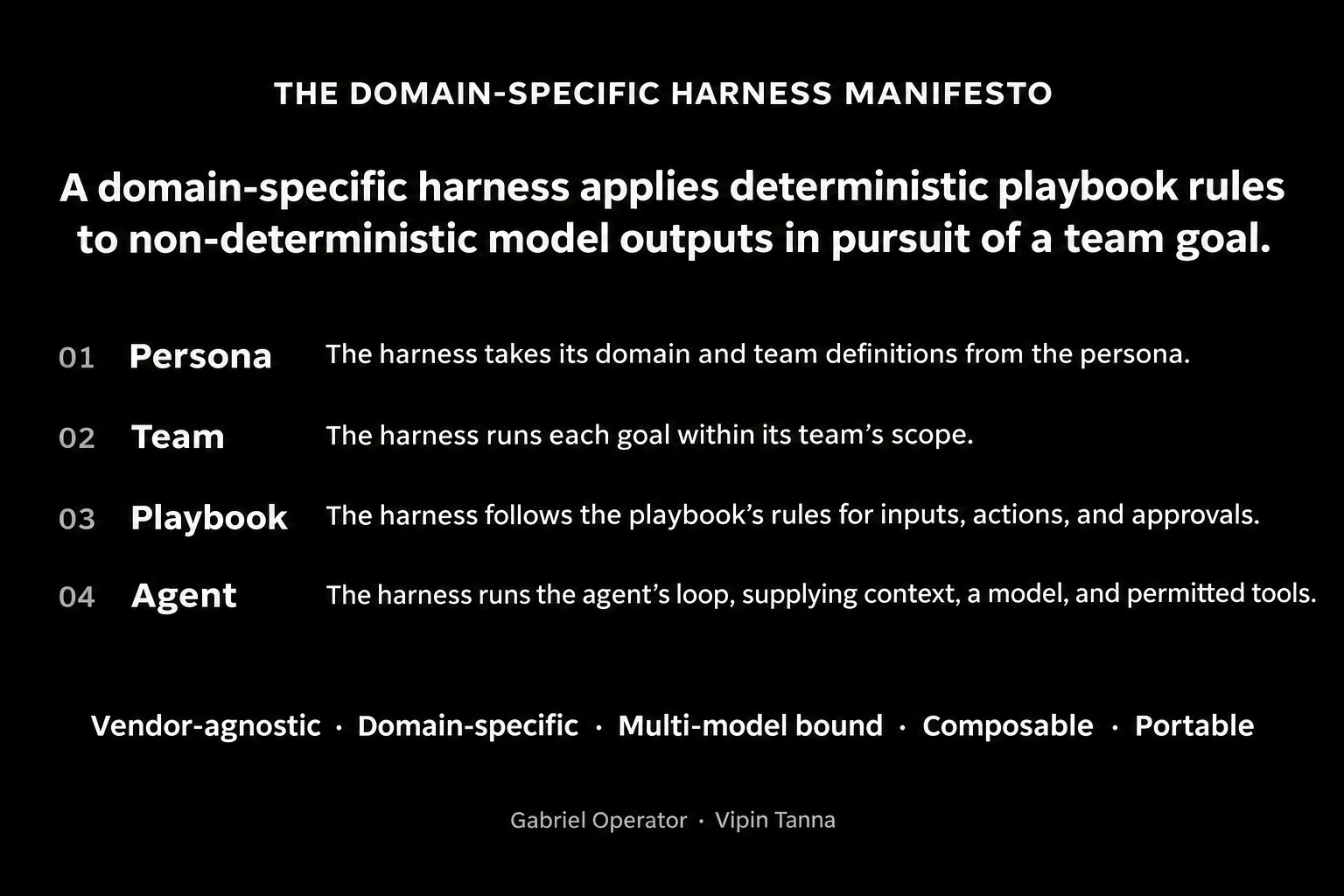 Enlarge poster
A domain-specific harness applies deterministic playbook rules to non-deterministic model outputs in pursuit of a team goal.
- Persona. The harness takes its domain and team definitions from the persona.
- Team. The harness runs each goal within its team’s scope, using the playbooks that team makes available.
- Playbook. The harness follows the playbook’s rules for inputs, actions, and approvals.
- Agent. The harness runs the agent loop with context, models, and permitted tools.
Playbooks should be vendor-agnostic, domain-specific, multi-model bound, composable, and portable. Declared inputs and outputs let teams compose playbooks, and versioned packages let workspaces reuse those definitions with compatible bindings.
Adapted from the Standard Agent Specification’s core principles.
Guide the harness by text or speech
Section titled “Guide the harness by text or speech”The harness should let people supply context, clarify intent, and review work through conversation. In Gabriel, Coach uses the persona’s domain and the selected workspace to understand the request. Inside a team, it can help set a goal or collect inputs for a playbook. The harness passes the context needed for that run to the agent. Text and voice use the same authorized operations, and protected actions still require human approval.
Coach can also walk a person through the harness on screen. With the person’s tab shared, it can open the team Canvas, show where to configure a connector, or fill a playbook draft for review. The person can take control at any time. See Coach computer use.
Vocabulary
Section titled “Vocabulary”| Term | Meaning in this specification |
|---|---|
| Persona | The Git definition of a domain model, its teams, and the playbooks those teams can use. |
| Runtime | Software that imports and verifies a persona, connects workspace resources, and coordinates execution. |
| Agent harness | The execution system that runs the agent loop, including model calls, context, and tool use. |
| Agent | An AI worker configured with instructions and tools. In a Gabriel team definition, the existing field for agent entries is teams[].bots. |
| Team | Agents and shared resources configured to work together. One persona can declare multiple teams. |
| Skill | Reusable instructions and supporting files that an agent can load. A playbook can carry its own skill and pin external skills. |
| Goal | A desired outcome for a team, with criteria for what counts as done. A goal can use existing playbooks or guide the authoring of a new one. |
| Playbook | A team-invocable capability with an executable workflow, inputs, outputs, and execution rules. Its skill provides the agent’s instructions and supporting files. |
| Connector / connection | A connector declares which external operations work may call. A connection is an authenticated account that a workspace supplies. |
| Workspace | One installation’s environment, with accounts, permissions, and state. |
For example, Lane is a persona for introductions and pilots. Lead researcher and Outreach coordinator are agents on one team. The steps for drafting and approving an email are a playbook. Sam’s connected Gmail account and the resulting email history belong to the workspace.
Existing names such as assets/persona-evals.json, teams[].bots, and published resource keys retain their current meaning. The vocabulary in the docs does not introduce aliases or require a file migration.
The definition of harness follows how OpenAI describes the Codex agent loop and Anthropic describes agent harnesses. The persona runtime owns import and workspace binding in this spec. The draft leaves the harness interface to each implementation.
Agent Skills
Section titled “Agent Skills”The persona’s root SKILL.md follows the Agent Skills format. A skills-compatible agent can read those instructions. Additional skills can live under skills/. A skill gives an agent reusable instructions and supporting files. A playbook makes that expertise available to a team goal by defining inputs, outputs, connector operations, and review rules in an executable workflow.
A persona adds a registry and declarative definitions for domains, data, workflows, and evals. A runtime uses those definitions to install the persona and apply its runtime rules. Agent Skills can include executable scripts. The definitions-only rule applies to the persona’s definition files.
Model Context Protocol
Section titled “Model Context Protocol”Model Context Protocol (MCP) defines how an AI application connects to servers that expose tools and resources. This draft describes which operations a workflow can request and how the runtime binds them to a connection. An MCP tool can satisfy a connector operation once the workspace authorizes the connection.
Agent2Agent (A2A)
Section titled “Agent2Agent (A2A)”Agent2Agent (A2A) defines how running agents discover one another and exchange tasks and results. An A2A Agent Card describes a service available to call. A persona registry pins files used to load a definition. The draft does not specify an A2A adapter.
Standard Agent Specification
Section titled “Standard Agent Specification”The Standard Agent Specification defines executable agents and their runtime interfaces. A Gabriel persona describes a domain and its teams in Markdown and JSON. Gabriel Studio can distribute playbooks, teams, and personas as npm packages.
| Standard Agent Specification | Related Gabriel concepts |
|---|---|
| Providers, models, prompts, and tools | Model providers, models, prompts, and tools |
| Agents and subagents | Agents, teams, and playbook delegation |
| Effects, hooks, and code execution | Scheduled work, lifecycle hooks, and code execution |
| Threads, messages, endpoints, filesystem, and execution state | Context and conversations, files and artifacts, and runs |
| Decisions | Prompted verification can evaluate a candidate against completion criteria during a Studio run. |
| Users (draft) | Workspace membership and resource binding determine which people and agents can act on local resources. |
| Runtime, packaging, and distribution | Runtime, packaging and installation, and marketplace |
These are conceptual mappings. Using a Standard Agents package in a Gabriel harness would require an adapter for execution, state, and workspace bindings.